 Ask About Our Discounts!

How Often to Stain a Fence in Highlands Ranch, CO: A 2026 Guide
Imagine opening your mailbox on a Tuesday in Highlands Ranch to find a formal HOA notice regarding your weathered cedar fence. It’s an all too common stress for neighbors in the 80129 zip code, especially since our 5,900-foot elevation subjects wood to 25 percent more UV intensity than sea-level properties. You likely want your home to reflect the care and integrity you put into your community, but Colorado’s rapid snowmelt cycles make maintenance feel like an uphill battle. It’s frustrating when conflicting advice leaves you wondering exactly how often to stain a fence in Colorado to prevent permanent rot.
We’re here to provide the clarity you need to protect your investment with purpose. You’ll discover the exact three-year maintenance timeline and the technical secrets to shielding your wood from 300 days of annual sunshine. We will explore the specific stain types that withstand the Front Range climate and how a meticulous application process preserves your home’s value while honoring our commitment to Painting with a Purpose. It’s time to transform your exterior into a lasting testament to your home’s beauty.
Key Takeaways
- Learn why the 6,000-foot elevation in Highlands Ranch demands a more proactive maintenance schedule to combat extreme UV exposure and freeze-thaw cycles.
- Master the 2026 standards for how often to stain a fence in Colorado, including the specific adjustments needed for sun-drenched, south-facing property lines.
- Compare the deep-penetrating benefits of oil-based stains against the color retention of water-based finishes to find the most durable shield for your wood.
- Recognize the critical physical signs of wood distress, such as graying, splintering, and checking, before they lead to costly structural failure.
- Discover how our meticulous “Painting with a Purpose” approach transforms routine fence maintenance into a meaningful investment for your home and the community.
The Highlands Ranch Climate: Why Your Fence Ages Faster at 6,000 Feet
Living in Highlands Ranch offers breathtaking views of the Front Range, but the local environment is notoriously harsh on exterior wood. At an average elevation of 5,920 feet, your property faces atmospheric conditions that differ drastically from lower-altitude regions. This elevation directly dictates how often to stain a fence in Colorado because the environmental stressors act with accelerated intensity. We view fence maintenance as an act of stewardship. It’s about preserving the integrity of your home’s perimeter through meticulous care and technical expertise.
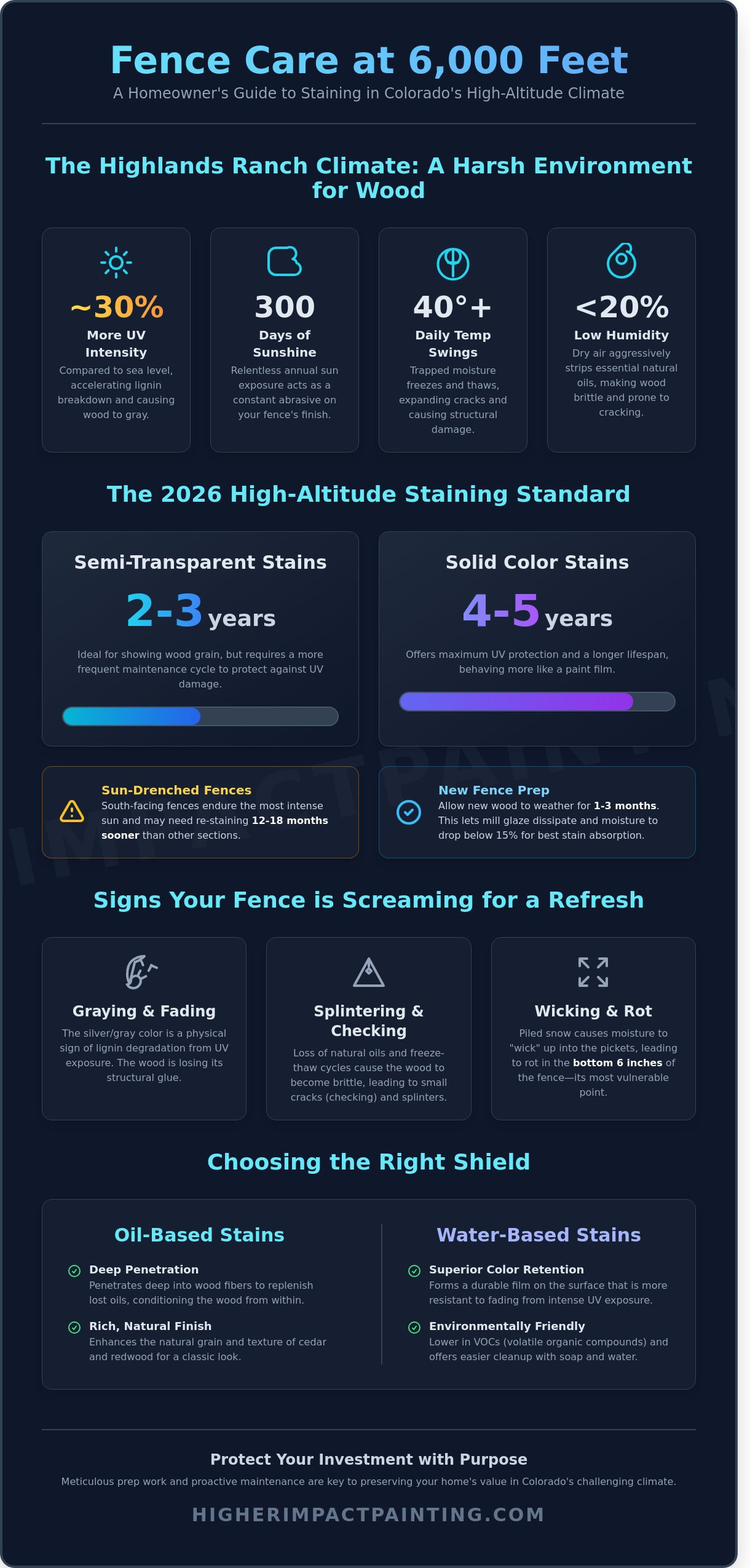
The low humidity in Douglas County, which often drops below 20% during summer afternoons, aggressively strips natural oils from cedar and pine pickets. Without these essential oils, wood becomes brittle and prone to deep structural cracks. Staining isn’t just a cosmetic choice; it functions as a sacrificial barrier that absorbs the brunt of the weather. To understand the composition of these protective layers, homeowners can explore What is Wood Stain? to see how pigments and binders shield the cellular structure of the timber. We apply these coatings with a mission to extend the life of your investment, ensuring your fence survives the 300 days of intense sunshine we experience annually.
The Science of UV Degradation in Colorado
UV radiation is the primary enemy of wood at high altitudes. For every 1,000 feet of gain in elevation, UV intensity increases by approximately 4% to 5%. In Highlands Ranch, your fence absorbs nearly 30% more solar radiation than a fence at sea level. This intense light breaks down lignin, the organic polymer that acts as the glue holding wood fibers together. When you notice your fence turning a dull silver or gray, it’s not just aging gracefully. That graying represents the physical loss of lignin. This leaves the wood fibers loose, porous, and unable to shed water, which eventually leads to total structural failure if left untreated.
Highlands Ranch Winter Snowmelt Impacts
The freeze-thaw cycle in Douglas County creates a violent physical reaction within the wood grain. During a typical January day, temperatures might swing from 10 degrees at night to 50 degrees by noon. This rapid change causes moisture trapped in the wood to expand and contract rapidly, widening small cracks into large fissures. Snow piles against the base of fence pickets during our spring blizzards, leading to a process called wicking. This is where moisture travels upward into the grain, causing localized rot at the bottom 6 inches of the fence.
At Higher Impact Painting, we practice Painting with a Purpose by focusing on these vulnerable transition points. By saturating the end grain of the pickets, we prevent the base from failing years before the rest of the structure. Determining how often to stain a fence in Colorado depends heavily on how well you protect these moisture-prone zones during the harsh winter months. We prioritize the long-term health of your wood because we believe every home improvement project should have a lasting, positive impact on the community.
How Often to Stain a Fence in Colorado: The 2026 Standard
Maintaining a Highlands Ranch property requires a disciplined approach to wood care. The 2026 standard for our high-altitude climate is clear: homeowners should plan to apply semi-transparent stains every 2 to 3 years. If you prefer the look of solid stains, these typically offer a longer window of 4 to 5 years. These timelines aren’t mere suggestions; they’re essential benchmarks to prevent structural failure. When you understand how weathering degrades wood through UV radiation and moisture cycling, you realize that Colorado’s 300 days of sunshine act as a relentless abrasive on your cedar or redwood pickets.
Don’t treat every side of your yard the same. South-facing fence lines endure significantly more UV intensity, often requiring professional attention 12 to 18 months sooner than shaded sections. This uneven wear is why many residents choose a localized maintenance schedule rather than waiting for the entire perimeter to fail. If you’ve just installed a new fence, patience is your best tool. We recommend a weathering period of 1 to 3 months before the first application. This allows the mill glaze to dissipate and the moisture content to drop below 15 percent, ensuring the pigment bonds with the grain rather than just sitting on the surface.
The longevity of your finish is ultimately dictated by the quality of the previous prep work. Meticulous cleaning and sanding allow the wood fibers to open up and accept the stain. Without this step, even the most expensive products will peel within 12 months. When considering how often to stain a fence in Colorado, remember that the type of pigment used is your primary defense against the elements. Heavier pigments provide more “sunblock” for your wood, extending the time between maintenance cycles.
Determining Your Specific Maintenance Cycle
You can check your fence’s health with a simple water bead test. Splash a few ounces of water onto several pickets. If the water soaks into the wood within 30 seconds, your protection has failed and moisture is reaching the core. Clear sealers are virtually useless in the Colorado sun. They lack the necessary pigment to block UV rays and typically require annual reapplication to prevent graying. Additionally, check your irrigation settings. Sprinklers that hit your fence daily can cut your stain’s lifespan by 50 percent, leading to localized rot and mineral staining that is difficult to remove.
HOA Compliance and Curb Appeal
Highlands Ranch HOAs are known for their meticulous standards, often requiring specific approved color palettes to maintain community harmony. Waiting until you receive a formal notice is a costly mistake. Proactive maintenance is roughly 30 percent cheaper than a restorative project because it avoids the need for aggressive chemical stripping or board replacement. A vibrant, well-maintained fence creates an immediate positive impact on your property value. If you want to ensure your home remains a source of pride for the neighborhood, our team can provide a professional wood assessment to help you stay ahead of the curve. Your fence is more than a boundary; it’s a reflection of your commitment to your home’s long-term integrity.
Choosing the Right Shield: Stain Types for Douglas County Homes
Selecting the right product for your fence isn’t just a matter of aesthetics; it’s a decision that impacts the structural integrity of your property. In Highlands Ranch, our wood faces a brutal combination of 300 days of annual sunshine and 5,920 feet of elevation. This intense UV exposure breaks down lignin in the wood cells faster than in lower altitudes. Understanding how often to stain a fence in Colorado depends heavily on which of these three shields you choose for your property. Each chemical composition offers a different level of defense against our semi-arid climate.
Why Oil-Based Wins in the Mile High City
Colorado’s humidity frequently drops below 10%, causing wood fibers to shrink, crack, and become brittle. Oil-based stains remain the gold standard for local craftsmen because they don’t just sit on the surface. They penetrate deep into the dry wood pores, replacing the natural oils lost to the sun. This deep saturation prevents the “graying” effect caused by moisture cycling. Our team at Higher Impact Painting favors this approach because it’s meticulous and purposeful. Reapplication is also simpler. You won’t need to spend hours sanding away old layers; you generally just need a professional cleaning and a fresh coat every 2 to 3 years to maintain the wood’s health.
Beyond the traditional choices, new technology is changing how we protect our outdoor spaces. Consider these three primary categories:
- Oil-Based Stains: These provide the best “internal” health for the wood. They’re easy to maintain and rarely peel, making them the most reliable choice for the 80% of Highlands Ranch homeowners who want a natural look.
- Water-Based Stains: These are excellent for staying power when it comes to vibrant colors. They dry quickly, but they require a moisture content below 12% during application or they’ll likely peel within the first 18 months.
- Hybrid Stains: This 2026 innovation combines the deep-reaching penetration of oil with the high UV-blocking power of acrylic resins. This technology aims to extend the life of your finish by 15% compared to traditional formulas.
The level of opacity you choose also dictates your maintenance schedule. Transparent stains show 100% of the grain but require the most frequent attention. Semi-transparent stains are our most requested option in Douglas County because they balance a beautiful wood-grain look with enough pigment to block significant UV rays. If you’re wondering how often to stain a fence in Colorado when using a high-quality semi-transparent oil, the answer is typically every 36 months to ensure the wood never reaches a point of failure.
The Case for Solid Stains in Older Fences
If your fence is over 10 years old or has visible graying and mismatched pickets, a solid stain is your best choice. It acts like a flexible skin, hiding imperfections while offering the maximum UV protection available on the market today. This choice ensures color harmony with your Highlands Ranch home’s exterior painting, especially if you match the fence to your home’s trim or siding. While it masks the grain, the trade-off is a uniform, purposeful aesthetic that can increase curb appeal by 5% to 11% according to local real estate data. We apply these with the same integrity we bring to every project, ensuring the film is thick enough to protect but breathable enough to prevent rot.
Signs Your Fence is Screaming for a Refresh
Your fence communicates its health through more than just aesthetics. In Highlands Ranch, the intense UV radiation at 5,920 feet elevation accelerates wood degradation faster than in lower altitudes. You’ll first notice the vibrant cedar or redwood hues shifting toward a dull, weathered gray. This “silvering” occurs when lignin, the natural glue holding wood fibers together, breaks down under sun exposure. Sunlight is relentless. When this protective layer fails, your wood becomes a sponge for snowmelt and spring rain.
Physical changes follow these visual cues. Splintering and “checking,” which are small cracks running parallel to the grain, indicate the wood is losing its internal moisture balance. If you see boards beginning to warp or pull away from the rails, the structural integrity is already at risk. In shaded sections of your yard, watch for green or black blooms. These biological growths trap moisture against the wood, accelerating rot from the inside out. Understanding how often to stain a fence in Colorado requires recognizing these early warning signs before they turn into permanent damage.
The ‘Water Test’ Diagnostic
To perform a reliable health check, splash a cup of water on three different areas: a high-sun picket, a shaded area, and a bottom rail. Observe the surface for exactly 30 seconds. If the water beads up and sits on the surface, your current seal is still holding strong. If the wood darkens and absorbs the liquid in under 30 seconds, your protective barrier is gone. Hydrostatic pressure is the physical force exerted by absorbed liquid that drives moisture and rot deep into the pores of unprotected wood.
The Cost of Procrastination
Neglecting maintenance creates a massive financial gap. A professional maintenance stain for a standard residential lot typically costs around $1,500. By contrast, a full fence replacement in today’s market can easily exceed $8,000 for materials and labor. We view fence care through the lens of integrity and stewardship. Much like drywall repair, catching small cracks and sealing them early prevents a minor blemish from becoming a structural failure that requires a total teardown.
Meticulous prep work is the secret to a finish that lasts. If you apply a new coat over gray, oxidized wood, the stain won’t bond; it will simply sit on the surface and peel within 12 months. Our team focuses on “Painting with a Purpose” by ensuring every board is cleaned and neutralized to open the wood pores. This allows the pigment to penetrate deeply, providing the long-term protection your home deserves. Knowing how often to stain a fence in Colorado is only half the battle; the quality of the application determines if that protection lasts three years or five.
Don’t wait for the wood to rot before taking action. Protect your home’s perimeter and increase your curb appeal by scheduling a professional fence staining assessment with our expert team today.
Higher Impact Painting: Protecting Highlands Ranch with Purpose
At Higher Impact Painting, we believe your home’s exterior does more than just shield you from the elements. It represents your investment in the Highlands Ranch community. Our “Painting with a Purpose” mission ensures that every fence we stain contributes to local strength. We don’t just apply product; we restore integrity to your property. While you might wonder how often to stain a fence in Colorado to maintain its beauty, our goal is to extend that window by providing a finish that stands up to 300 days of annual sunshine. We treat every project as a partnership. This means we prioritize your home’s longevity and the visual harmony of your neighborhood over quick, transactional work.
Our team understands the unique challenges of the Front Range. The Highlands Ranch wind can reach speeds of 45 miles per hour without warning. To prevent overspray on your expensive landscaping or your neighbor’s car, we utilize a combination of hand-rolling and specialized shielding techniques. We maintain clean job sites because we respect your space as much as our own. Clear communication is our standard. You’ll receive daily updates so you’re never left guessing about our progress. Our 98% customer satisfaction rating in Douglas County reflects our commitment to being the most reliable craftsmen in the area.
Our Meticulous 3-Step Staining Process
Our approach starts with a deep cleaning. We use professional-grade pressure washers to strip away graying wood fibers and microscopic mold spores that thrive in shaded corners. Next, we employ a back-brushing technique. Instead of just spraying the surface, we manually force the stain deep into the wood grain. This method provides 2x longer protection than standard spray-only applications. Finally, we conduct a detailed inspection. We verify that the color matches your specific HOA requirements exactly. This ensures 100% coverage across every picket and rail before we consider the job finished.
Transforming Your Property Value
Investing in a fresh stain delivers a 150% return on investment regarding your home’s curb appeal. It’s the highest impact project you can undertake for the price point. We often coordinate these services with your larger exterior painting or deck restoration projects to ensure a cohesive look. Our 2024 project data shows that professionally maintained fences last 12 years longer than neglected ones. Knowing how often to stain a fence in Colorado is easier when you have a partner dedicated to your home’s longevity. Take the first step toward a more beautiful property today.
Ready to revitalize your home? Get a Free Fence Staining Estimate in Highlands Ranch and experience the difference of a mission-driven team.
Preserve Your Highlands Ranch Perimeter with Purpose
Your fence does more than mark a boundary; it protects your sanctuary. At an elevation of 6,000 feet, the intense UV radiation in Douglas County degrades wood fibers twice as fast as sea-level environments. Understanding how often to stain a fence in Colorado is the first step in proactive home maintenance. While 2026 standards suggest a refresh every 2 to 3 years for semi-transparent stains, your specific results depend on the quality of application. We focus on longevity by using high-altitude specialized materials engineered to withstand our thin air and heavy snow.
Higher Impact Painting is locally owned in Highlands Ranch and committed to more than just a surface-level finish. We utilize a meticulous back-brushing technique to ensure every ounce of protection penetrates deep into the wood grain. This disciplined approach reflects our mission of Painting with a Purpose, where technical excellence meets community integrity. Don’t wait for the wood to gray or splinter before you act. Schedule your free Highlands Ranch fence assessment today! We are excited to help you transform and protect your home with a finish that truly lasts.
Frequently Asked Questions
Is it better to paint or stain a fence in Highlands Ranch?
Stain is the superior choice for our local climate because it penetrates the wood fibers rather than sitting on top of them. Paint often cracks or peels within 24 months due to Colorado’s 300 days of intense annual sunshine. We choose high-quality stains to protect your home’s integrity, ensuring the wood breathes naturally while resisting the moisture from our heavy spring snows.
Can I stain my fence in the winter in Colorado?
You shouldn’t stain your fence during the winter if temperatures drop below 50 degrees Fahrenheit. A successful application requires a 48-hour window where the thermometer stays above this mark to allow for proper curing. Since Highlands Ranch averages 140 nights of freezing temperatures per year, we schedule most projects between April and October to ensure a transformation that lasts for years.
How much does professional fence staining cost in Highlands Ranch?
Professional fence staining in Highlands Ranch typically costs between $3.50 and $5.50 per linear foot for standard 6-foot cedar privacy fences. For a typical residential lot with 160 feet of fencing, homeowners usually invest between $800 and $1,200 in their property. This price includes our meticulous preparation process and premium materials, reflecting our commitment to providing value and beauty to our local community.
Do I need to sand my fence before restaining it?
You only need to sand your fence if the wood fibers have become “fuzzy” or raised after a high-pressure power wash. Our team typically sands about 10 percent of the surface area on older fences to create a smooth, receptive surface for the new finish. This disciplined step ensures the product bonds correctly, which is a vital part of our “Painting with a Purpose” mission.
How long does stain need to dry before it rains in Colorado?
Your fence needs at least 24 hours of dry weather to cure before the next Colorado rainstorm or afternoon shower. If moisture hits the wood within the first 12 hours, it can cause the pigment to streak or wash away entirely. We monitor local weather patterns 3 days in advance to ensure your project has the perfect window for a durable and beautiful result.
What is the best color for a fence in a Highlands Ranch HOA?
The most successful colors for Highlands Ranch HOAs are semi-transparent earth tones like “Oxford Brown” or “Natural Cedar.” Over 85 percent of local neighborhoods require these specific shades to maintain a cohesive and professional community aesthetic. We always recommend checking the HRCA residential improvement guidelines first. Our team helps you navigate these rules to ensure your project meets every local standard perfectly.
Why is my fence turning gray so fast?
Your fence turns gray because UV radiation destroys the wood’s lignin, a process that happens 20 percent faster at our high altitude than at sea level. Without a protective finish, raw cedar starts showing silver-gray oxidation within 90 days of exposure. We use stains with high pigment loads to block these rays. This technical choice preserves the wood’s strength and keeps your environment looking vibrant.
How often should I stain a new cedar fence?
You should stain a new cedar fence approximately 4 to 6 months after installation once the wood has properly seasoned. Understanding how often to stain a fence in Colorado starts with this initial application to prevent the wood from drying out too quickly. Cedar contains natural oils that must weather out until the moisture level hits 12 percent, ensuring the stain absorbs with deep, purposeful protection.